EVAR for Abdominal Aortic Aneurysm in Sugar Land, TX
A stent graft placed through small groin openings to reinforce a weak section of the aorta, without a large abdominal incision.
At a glance
- Typical time
- Often 2 to 3 hours
- Downtime
- Many people go home within a day or two, and return to light activity within a couple of weeks
- Anesthesia
- General, regional, or local with sedation, chosen with your care team
Quick answer
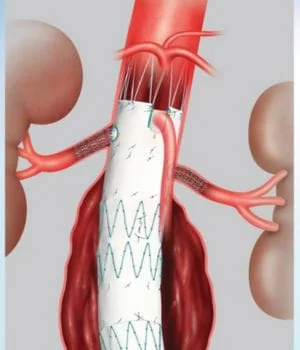
EVAR, or endovascular aneurysm repair, treats an abdominal aortic aneurysm from inside the artery. A stent graft is placed through small openings in the groin to line the weak section of the aorta, so blood no longer pushes against the bulge. It avoids a large abdominal incision, but needs lifelong imaging follow-up.
- Small groin openings, not a large abdominal incision
- Needs the right shape of aneurysm to be possible
- Lifelong imaging follow-up after the procedure
What is EVAR?
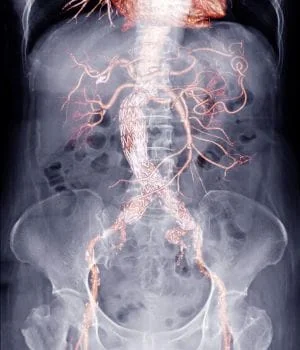
EVAR stands for endovascular aneurysm repair. An aneurysm is a weak, bulging section of an artery wall. In the aorta, which is the body’s largest artery, a large aneurysm can burst. EVAR repairs it from inside the artery with a stent graft, which is a fabric tube held open by a metal frame. The graft carries blood through the weak section, so pressure on the bulge drops.
Who is it for?
EVAR may be an option if you have an abdominal aortic aneurysm that is large enough, or growing fast enough, to need repair, and a CT scan shows that its shape suits a stent graft. Small aneurysms are often just watched with scans. Not every aneurysm can be treated with EVAR, and some need open surgery.
See our page on aortic aneurysm.
How does the procedure work?
- Planning. A CT scan maps your aorta and measures the aneurysm.
- Access. The surgeon reaches the arteries in the groin through small openings.
- Placing the graft. Using X-ray guidance, the graft is guided up into the aorta and opened to line the weak section.
- Checking. Dye and X-rays confirm that blood flows through the graft and not into the aneurysm.
- Closing. The groin openings are closed.
What does it feel like?
You are asleep, or numbed and sedated. Afterward, the groin openings can be sore and bruised for several days.
What can I expect afterward?
Many people stay one or two nights and go home. You will get written instructions about activity, lifting, and wound care. Light activity returns within days to a few weeks. You will need imaging, usually CT or ultrasound, at set times after EVAR, for life. This is how problems are caught early.
What are the risks?
EVAR avoids a large incision, but there are risks, including:
- Bleeding or injury to the arteries at the groin
- Kidney problems from the dye used during the procedure
- An endoleak, which is blood leaking around the graft
- The graft shifting or blocking
- Infection or blood clots
- A need for another procedure later
Dr. Rema Malik will go through these with you.
Call 911 for sudden, severe belly, back, or flank pain, especially with dizziness or fainting. These can be signs of an aneurysm that has burst.
How is it different from other options?
- Watching with scans is common for small aneurysms.
- Open repair replaces the weak section through a larger cut in the abdomen. It is a good choice for some people.
- EVAR uses small openings and often means a shorter recovery, with lifelong follow-up.
What happens before you decide?
You start with a visit, an exam, and imaging. You leave knowing the size and shape of your aneurysm, and whether to watch it, or repair it with EVAR or open surgery. You do not need a referral.
Conditions this treats
Frequently asked questions
Still have a question?
Our team answers the phone Monday to Friday, 8 AM to 5 PM.
Who can have EVAR?
People whose aneurysm has the right shape and location for a stent graft, found on a CT scan. Some aneurysms are not suitable, and open surgery may be better. Dr. Rema Malik will review your scan with you.
How is EVAR different from open surgery?
Open repair uses a larger cut in the abdomen to replace the weak section. EVAR works from inside the artery through small groin openings. Recovery is usually shorter with EVAR, but it needs lifelong imaging follow-up.
Why is follow-up needed after EVAR?
The graft can shift, or blood can leak around it, called an endoleak. Regular imaging checks for this so it can be fixed early.
What are the main risks?
Bleeding, kidney problems from contrast dye, an endoleak, infection, and blood clots. Dr. Rema Malik will go through them with you before the procedure.
Do I need a referral?
No. You can call and schedule a visit directly.
Will insurance cover it?
Many plans cover EVAR when it is medically needed. Coverage differs by plan. We can explain what to expect after your visit.
Not ready to book? Get the monthly newsletter.
Plain-language vein and vascular guidance from Dr. Malik, once a month.
Ready to talk to a vascular surgeon?
Same-week appointments. No referral needed. Most insurance accepted.